In Baltimori, Peru, one of the activities is enrichment planting in secondary forest, areas where only a few tree species have taken hold as part of the forest's own survival strategy after disturbance. Enrichment planting speeds up the return of tree species that are useful for human needs, including endangered species, and brings a broader range ...Read more
In Baltimori, Peru, one of the activities is enrichment planting in secondary forest, areas where only a few tree species have taken hold as part of the forest's own survival strategy after disturbance. Enrichment planting speeds up the return of tree species that are useful for human needs, including endangered species, and brings a broader range of biodiversity back into the landscape sooner than natural regeneration alone would.
The site covers 8.41 hectares in total, made up of two non-contiguous, nearby areas of 2.73 and 5.68 hectares respectively.
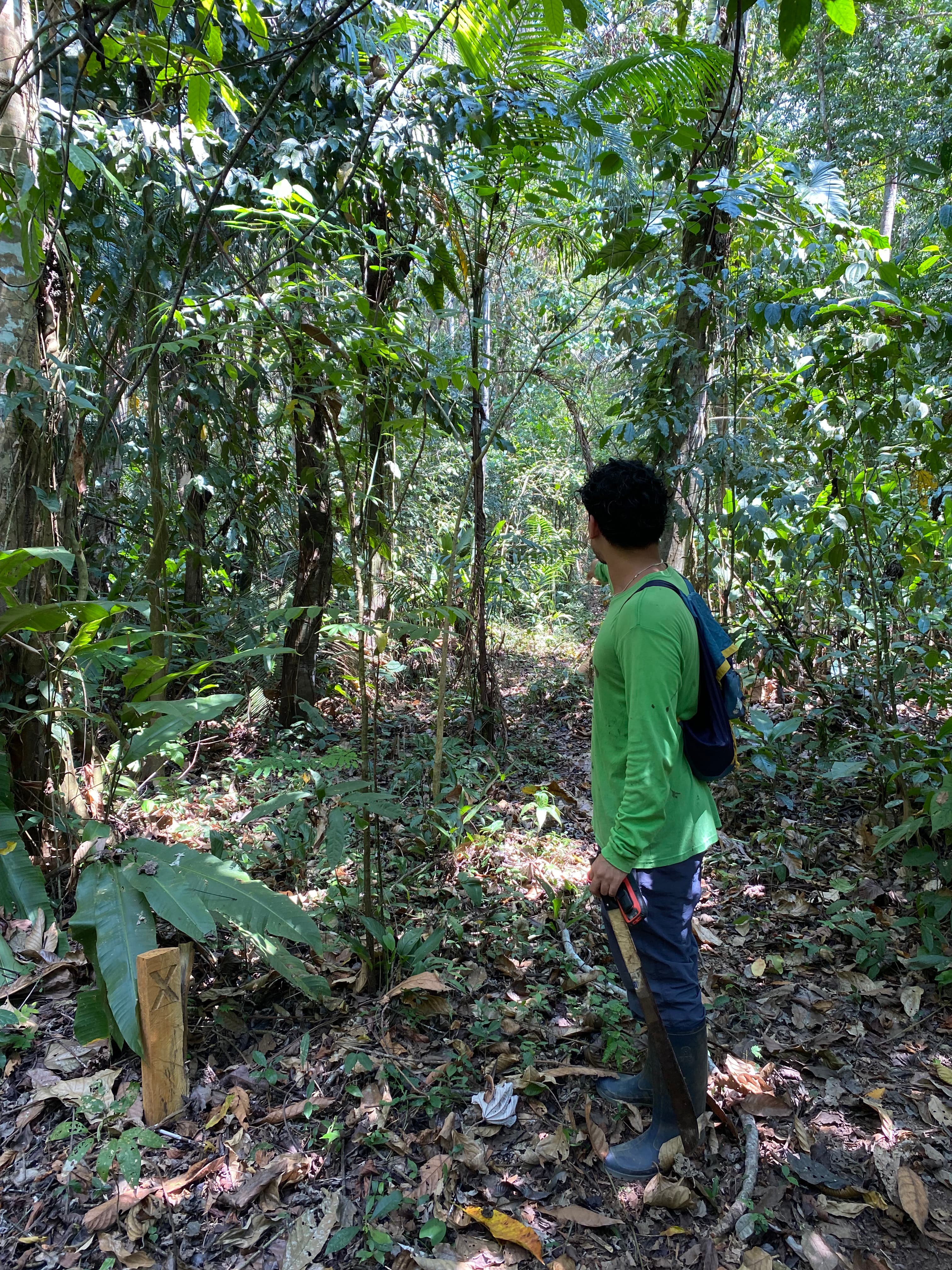
"Enrichment strips" is a commonly used term in restoration and silviculture literature, referring to rows of high-value trees planted within fallows, degraded areas, or secondary forests. In Camino Verde's case, these strips are planted within secondary forests that are 10 to 25 years old. This land was previously farmed by the site's former owner for bananas, corn, rice, and cassava, sold at the local market.
Slashed and burned for farming and then left to grow back, these forests are now a couple decades old and already have a somewhat closed canopy, made up of a few predominant pioneer species native to the region, such as balsa wood (Ochroma pyramidale) and cetico (Cecropia sp.). These native pioneer species are very effective at building up organic matter to rebuild soils. They are also short-lived, with a maximum lifespan of 30 to 50 years, so as they grow old, their understory is naturally repopulated with a greater diversity of tree species, dispersed by birds, bats, and tree-dwelling mammals.
Planting enrichment strips in this environment can be thought of as speeding up natural ecological succession, so that a greater diversity of species is present sooner, and the secondary forest transitions to a high-diversity primary forest faster than it otherwise would. This would ordinarily take 100 to 200 years. Our enrichment planting directly increases the presence of endangered species in the secondary forest. Alongside this ecological diversification, enrichment planting also enriches the forest in the economic sense, bringing more valuable species into the landscape sooner.
Planting within secondary or degraded forest keeps maintenance costs relatively low, requiring only one or at most two weedings per year, since weeds grow more vigorously in full sun and the existing canopy limits that. At the same time, that same canopy leads to a higher death rate among planted seedlings, since branches frequently fall on them from above. Best practice for this planting system is therefore a high planting density. The planting strips are spaced 5 or 10 meters apart, are 1 to 1.5 meters wide, and are hand-cleared of undergrowth with machetes. Trees are planted along the rows every 0.5 meters, giving a planting density of 4,000 trees per hectare where strips are spaced every 5 meters, or 2,000 trees per hectare where strips are spaced every 10 meters. In some experimental rows, this density was increased further by planting in a zigzag pattern (locally called "tresbolillo") within the cleared strip, allowing for 1.5 times as many trees per row, or 3,000 to 6,000 trees per hectare.
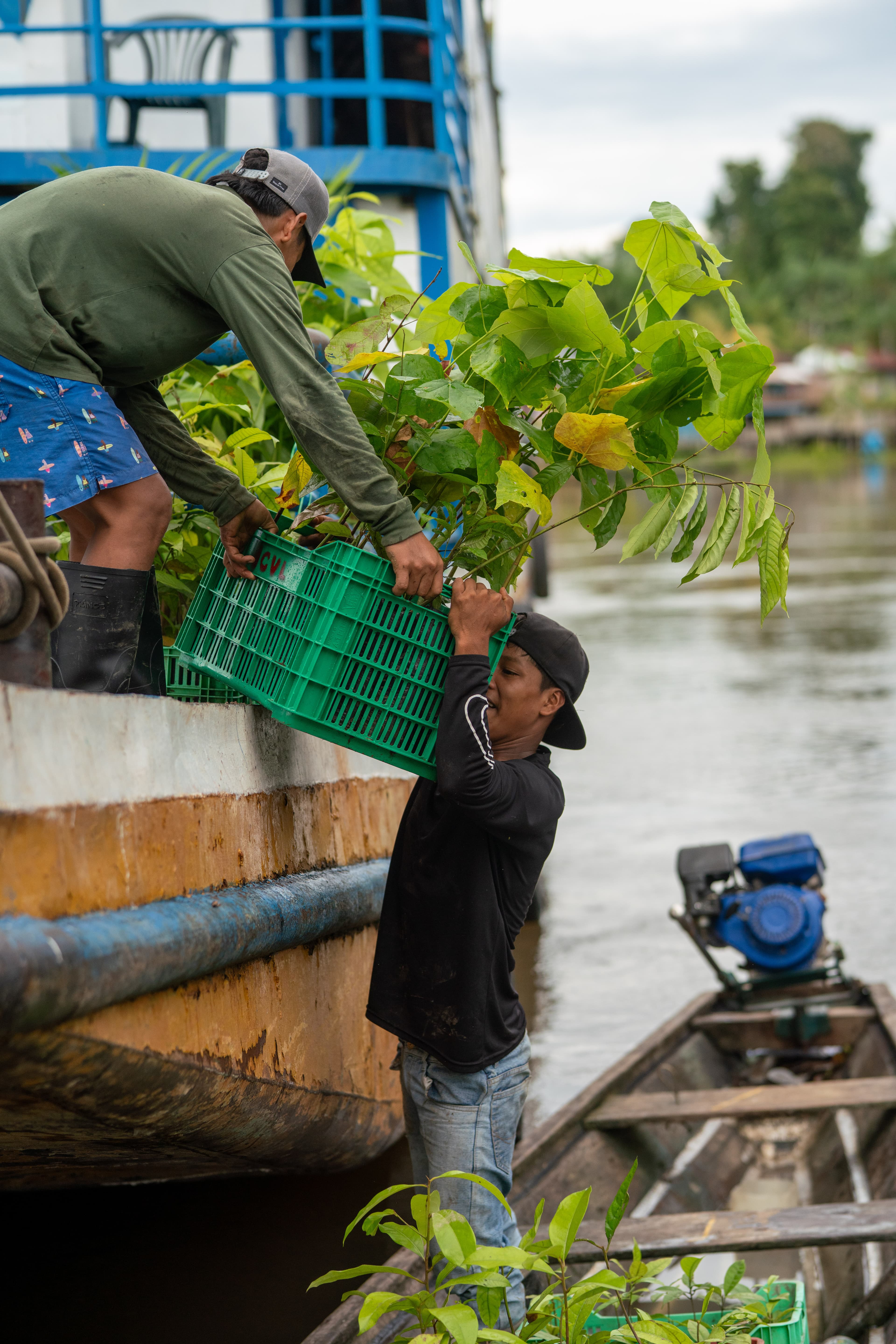
The process begins with seed collection in the surrounding forests. Once seeds have grown into seedlings, they are stored safely and go through a hardening process to improve their survival rate once planted. When the rainy season arrives, the seedlings are planted out into the forest.
Between 2021 and 2026, 24,625 trees were planted in enrichment strips in the secondary forest with the help of Go Forest clients. Species include Canela Moena, Cacao, Quillusisa, Moena Naranja, Espintana, Huayo Blanco, Huasaí, Asaí, Ungurahui, Catahua, Bombonaje, and Caoba.
)
)
)
)
)
)